
Non-Human and AI Identity Management
Discover, review, and govern every identity that is not a person.
Service accounts, machine credentials, and AI agents...
What counts as a non-human identity
Service accounts
Directory accounts that let an application, script, or scheduled job authenticate to another system without a person present. They are created for one integration, granted broad rights so the integration does not break, and then never revisited. Most environments hold hundreds that no current employee can explain.
svc_payroll_batch · sql_reporting_svc · adconnectorAPI keys and OAuth clients
Bearer secrets and client credentials that grant programmatic access to an application or its data. Whoever holds the key holds the access. No password policy, no expiry, and no login event that looks unusual, because every call looks like the same authorized client.
client_id + client_secret · personal access tokensCertificates and SSH keys
Cryptographic identities used for machine-to-machine trust and administrative access to servers. Expiry dates are usually tracked because an expired certificate causes an outage. Ownership is usually not, because an unowned key causes nothing until it is used against you.
TLS client certs · authorized_keys entriesRPA bots and automation workers
Software robots that sign into business applications the way an employee would, often carrying a real person's entitlement set because that is how the process was built. To the application the bot is a user. To the access review it is usually invisible.
UiPath and Automation Anywhere runners · ETL jobsCloud workload identities
Managed identities, service principals, IAM roles, and instance profiles that let compute call cloud services without a stored secret. Removing the secret solved one problem and created another. Permissions attach to the role, roles are reused across workloads, and effective access is far wider than any single assignment suggests.
Azure managed identities · AWS IAM roles · GCP service accountsContainer and Kubernetes identities
Short-lived service accounts issued to pods and microservices by the orchestrator. They are created and destroyed by automation at a rate no manual process can track, which means the inventory is stale the moment it is written and default service accounts quietly accumulate cluster-wide rights.
Kubernetes service accounts · workload identity bindingsDatabase and platform-local accounts
Logins that live inside a database, mainframe, or core banking platform rather than the directory. Directory-based reviews never see them. They are frequently the most privileged accounts in the institution and the ones examiners ask about first.
SQL Server logins · Oracle schema accounts · core system IDsThird-party and vendor credentials
Access held inside your estate by managed service providers, resellers, implementation partners, and contractors. The credential is yours, the person using it is not, and the offboarding process that would remove it belongs to a company you do not control.
MSP admin accounts · vendor support logins · partner connectorsAI agent identities
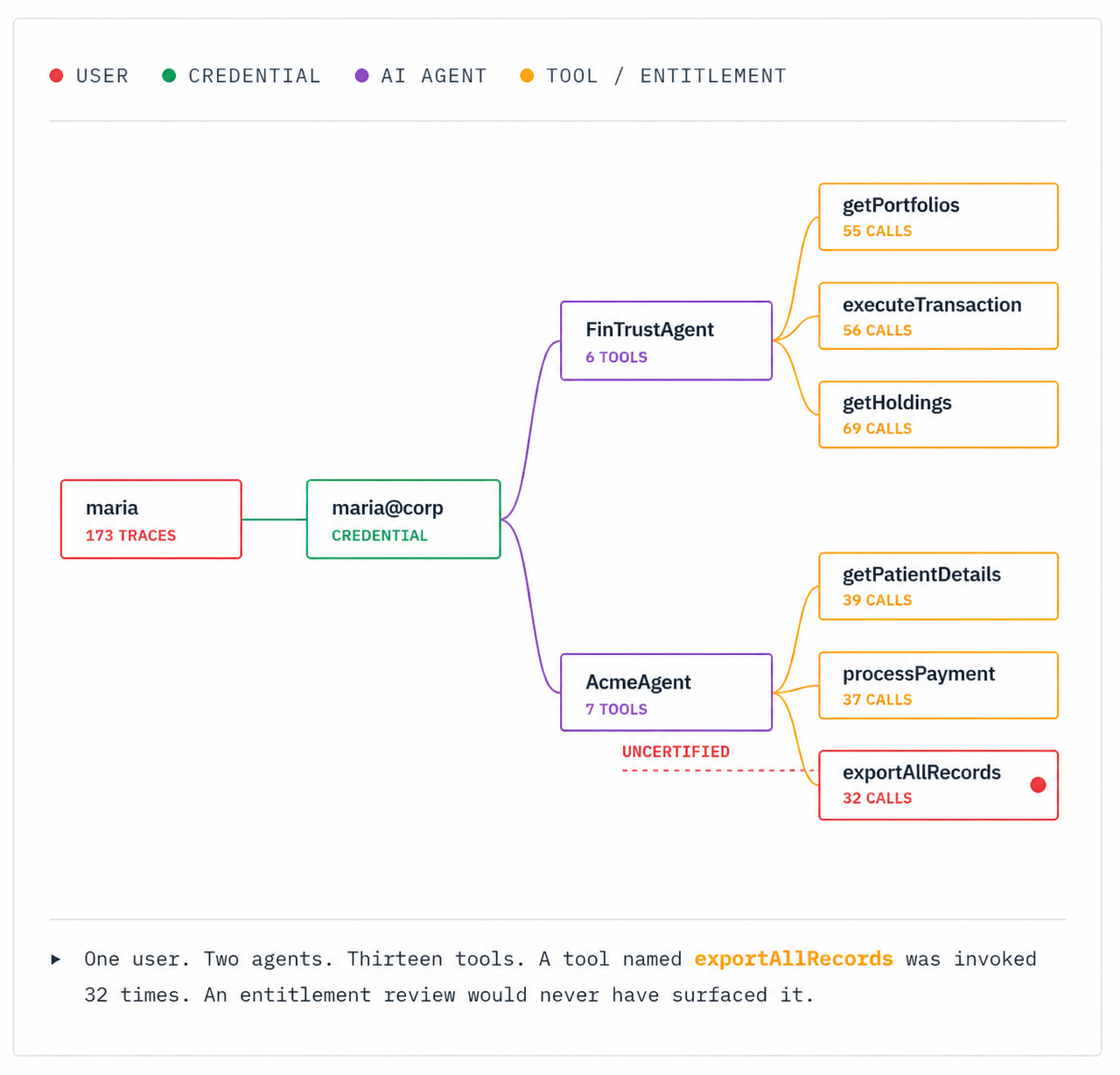
The credential an AI agent authenticates with to call tools, read records, and take action. The agent rarely holds permissions directly. It inherits them through a project role, a managed identity, or a delegated user token, so what appears on the agent record is not what the agent can actually reach.
Azure AI Foundry project roles · Copilot Studio assignments · MCP tool grantsFind every identity that is not a person
You cannot govern what you have not found. Most programs start with a spreadsheet assembled two years ago and a directory query that catches a fraction of what exists. Discovery is the hardest part of this work, and it is where SecurEnds starts.
Directories and infrastructure
- Active Directory and Entra ID service accounts
- LDAP directories
- Local accounts on Windows and Linux hosts
- Scheduled task and Windows service accounts
Core business systems
- Jack Henry SilverLake and Symitar
- Fiserv Premier and DNA
- FIS Horizon
- Mainframe, midrange, and ERP integration IDs
Databases and cloud
- SQL Server, Oracle, PostgreSQL, MySQL logins
- Azure managed identities
- AWS IAM roles and instance profiles
- Kubernetes workload identities
Secrets and automation
- API keys and OAuth clients
- Certificates and SSH keys
- RPA bots and ETL jobs
- SaaS integration credentials
AI Infrastructure CONFIRMED IN PRODUCT
- Azure AI Foundry agents
- Copilot Studio assignments
- MCP servers
- Role grants rendered in plain language
- Credential resolution
Third party and vendor
- Vendor connectors
- Managed service providers
- Contractor credentials
- Third-party identities
Connect once
More than one hundred prebuilt connectors with agentless discovery across cloud, SaaS and legacy systems.
Detect what changed
Discovery reruns automatically and reports only what changed instead of rebuilding inventories.
Classify what you find
Every credential is identified as human, non-human or AI identity using built-in intelligence.
Attribute what you find
Every identity receives an owner, business purpose and governance lifecycle.
Certify non-human access
like you certify everyone else
Most organizations run a disciplined review for employees and no review at all for service accounts. That gap is where audit findings come from. SecurEnds puts non-human identities and AI agents into the same campaigns, with the same evidence trail.
🟢 svc_wire_batch
Reviewers see evidence, not a checkbox
Owner, business purpose, every entitlement held, last authentication, dormancy, and whether the entitlement has ever been exercised. For agents, the effective access through inherited roles and the tools actually invoked.
Campaign templates keep quarters comparable
Scope is standardized so this quarter looks like last quarter to an examiner. Scheduling runs campaigns without someone remembering to launch them.
Delegation and exceptions have a paper trail
Items route to the right owner when a manager is unavailable. Accounts that cannot be revoked carry documented justification, ownership and expiry.
Evidence exports instead of assembling
Completion rates, revocations, exceptions and decision history are exported in the format auditors request. No last-minute preparation before fieldwork.
Provision, govern, and deprovision
A review that ends in a decision nobody executes is theater. SecurEnds closes the loop by connecting requests, approvals, and revocations to the systems that actually grant and remove access.
Nothing is created without an owner
New service accounts and agent identities are requested through a workflow, not a ticket to an administrator. Every request carries a named owner, a justification, a defined scope, and a mandatory expiration date.
Policy decides who signs off
Policy templates determine which approvals are required for each level of access. High-privilege requests route to additional approvers automatically.
Least privilege at creation
Approved requests provision through SCIM and native connectors. Access templates grant only the permissions required for the role.
The decision actually executes
Revocations flow directly into removal. Deprovisioning also occurs when owners leave, projects close, or expiration dates are reached.
Any credential that authenticates without a person behind it. Service accounts, API keys, certificates, SSH keys, OAuth clients, RPA bots, container workloads, cloud roles, and AI agents are all non-human identities. They typically outnumber human users and often hold broader access.
Agentless discovery connects to directories, databases, cloud platforms, core banking systems, and business applications through hundreds of connectors and scheduled scans.
Yes. Service accounts and AI agents participate in the same certification campaigns as employees, including ownership, entitlements, authentication history, and usage evidence.
AI agents authenticate using managed identities, service principals or delegated credentials to call tools, read records and perform automated actions.
Decisions from certification campaigns trigger automated deprovisioning through connected systems such as SCIM, Active Directory and cloud platforms.
No. SecurEnds governs identities, ownership and entitlements while integrating with existing PAM and secrets management platforms.
Bring your non-human
identities under control
Non-human identities already outnumber your employees, and AI agents are growing faster than either. Left undiscovered, they are the largest ungoverned population in your environment. SecurEnds finds them, shows you what they can reach, and executes the decision.



