
Turn Access Data Into Actionable Roles
Understand how access is actually distributed across your organization. SecurEnds analyzes identity-to-access relationships to uncover common patterns, identify outliers, establish role and access baselines, and turn those insights into governed Access Templates that can be used across the identity lifecycle.
Role design gets harder as access grows
Organizations accumulate access over years of hiring, transfers, reorganizations, application changes, and one-off requests. Roles are often documented in spreadsheets, built through workshops, or based on assumptions about what users should have. Over time, this can create inconsistent access, excessive privileges, difficult-to-maintain role models, and limited visibility into what “normal” access actually looks like.
A scalable RBAC model needs evidence
Build your access model from real access relationships
SecurEnds brings identity, application, account, and entitlement data together using out-of-the-box ingestion mechanisms including pre-built connectors, Flex Connectors, and file-based uploads. Identity metadata from systems of record—such as department, location, job title, job code, and other customer-defined attributes—can then be used to segment populations and analyze how access is distributed.
Identity Context
Use the identity attributes relevant to your organization to define populations and peer groups for analysis.
Application & Entitlement Data
Analyze downstream accounts and entitlement catalogs including roles, groups, permissions, and other access objects.
Access Prevalence
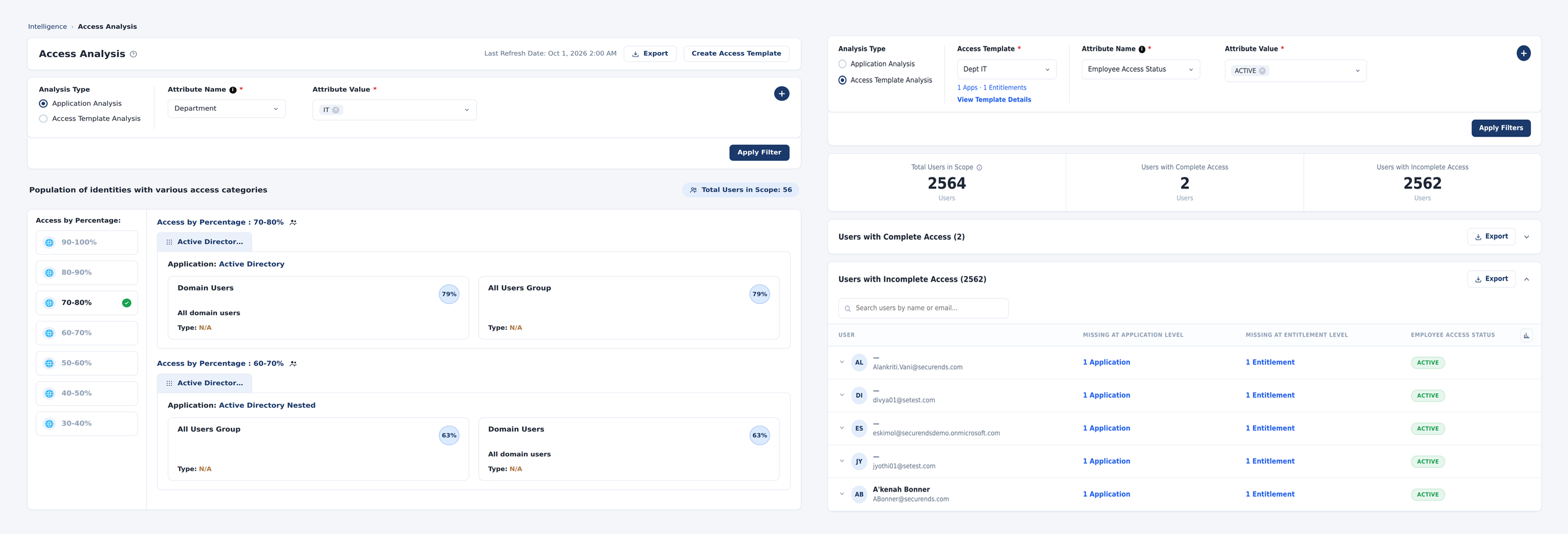
See access distribution by percentage—from highly common access to uncommon access and everything in between—to understand what is typical for a selected population.
SecurEnds Access Analysis
From fragmented access to a governed RBAC framework
Access Analysis helps teams move from raw identity and entitlement data to a repeatable model for defining, governing, and maintaining access.
Ingest
Bring in identity, account, application, and entitlement data.
Segment
Filter populations using department, location, title, job code, and other attributes.
Analyze
Scan access relationships and measure how commonly each access item occurs.
Discover
Identify baseline access, role candidates, peer patterns, and access outliers.
Build
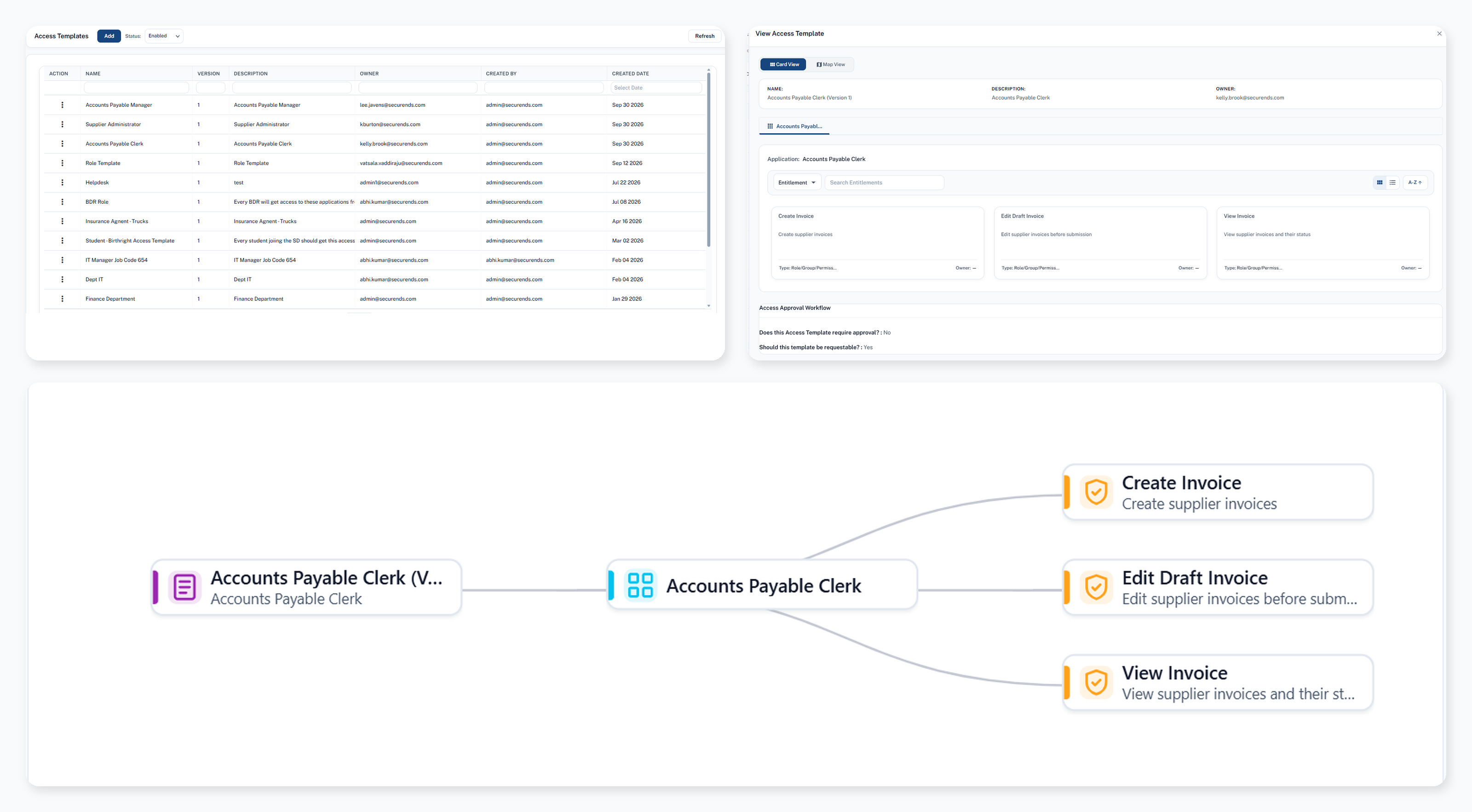
Convert validated patterns into reusable SecurEnds Access Templates.
Govern
Version, approve, review, and maintain templates as the organization changes.
Find the right level of access for the right population
Organizations can use access prevalence and identity context to establish an RBAC hierarchy that reflects their operating model. Instead of forcing every organization into one role structure, SecurEnds helps teams analyze access at the dimensions that matter to them.
Birthright Access
Identify access that is consistently required across broad populations and may be appropriate as a baseline.
Department & Location
Discover access patterns shared by users within organizational units or geographic locations.
Job-Based Access
Analyze job title, job code, function, or other attributes to identify repeatable access requirements.
Specialized Roles
Separate common baseline access from access required by narrower functions or responsibilities.
Peer & Outlier Analysis
Surface users or permissions that differ from established peer patterns for additional investigation and governance.
Customer-Defined Models
Use the identity metadata and filtering conditions that align with your organization's own RBAC framework.
How Access Analysis Forms an RBAC Model
A conceptual view of how identity context and access prevalence can be translated into progressively more specific access baselines.
1. Define the population
Department: FinanceLocation: DallasJob Code: FIN-102Job Title: Analyst2. Establish access layers
Role mining shouldn't end with role discovery.
SecurEnds turns validated access patterns into Access Templates—governed objects that can be used operationally instead of remaining static analysis. Templates can become a common access definition across access requests, lifecycle processes, access reviews, and ongoing governance.
Keep roles accurate after they are created
Role models are not static. Applications are introduced and retired, permissions change, responsibilities evolve, and organizational structures shift. SecurEnds provides governance around Access Templates so role maintenance becomes an ongoing controlled process rather than another spreadsheet exercise.
Maintain an organized catalog of Access Templates.
Track how template composition changes over time.
Route proposed additions, removals, and modifications through governance workflows.
Remove obsolete access when applications or entitlements are decommissioned and incorporate new access as needed.
Periodically review template contents quarterly, semiannually, annually, or according to policy.
Apply approved template changes to downstream identity governance processes and affected populations as appropriate.
Inside a Governed Access Template
An Access Template can represent multiple applications, the entitlements within those applications, accountable owners, and a controlled version history.
Finance Analyst
Reusable access bundle for request, lifecycle, and review processes.
Status: ApprovedVersion: 3.2Reporting-Readers
Corporate-VPN
Cost Center Reporting
Invoice Viewer
Knowledge Reader
Version history
Initial template
Added SAP access
Removed legacy app
Current approved composition
Composition view
Access Template
One analysis capability. Multiple governance outcomes.
Role Mining & Role Engineering
Discover recurring access patterns and use them as evidence for designing or refining an enterprise RBAC model.
Access Baseline Discovery
Determine what access is common for specific departments, jobs, locations, or other identity populations.
Outlier Detection
Compare identities against peer access patterns to identify uncommon access relationships that may warrant investigation.
Access Request Simplification
Use Access Templates to present meaningful bundles of access instead of requiring users to understand individual technical entitlements.
Lifecycle Automation
Use governed templates as access baselines for onboarding and job changes, helping translate identity attributes into appropriate access.
Continuous Role Governance
Review role composition and maintain role hygiene as applications, entitlements, and business requirements evolve.
Peer & Outlier Analysis
Use this location for a SecurEnds screenshot that demonstrates uncommon access, peer comparison, or exceptions discovered during analysis.
Recommended: include enough product context to show why the access is unusual
Make access decisions easier to explain, operate, and govern
Reduce Manual Role Engineering
Use organization-wide access data to support role design instead of relying only on interviews, workshops, and spreadsheets.
Improve Consistency
Establish repeatable access baselines that can be reused across request, lifecycle, and review processes.
Strengthen Least-Privilege Governance
Make unusual access easier to identify by comparing users against relevant peer populations and established patterns.
Keep RBAC Sustainable
Govern the full lifecycle of Access Templates through inventory, versioning, approvals, composition reviews, and ongoing maintenance.
Connect Analysis to Operations
Move beyond static reports by turning access insights into governed templates that support day-to-day identity governance.
Adapt to Your Organization
Analyze access using the identity attributes and RBAC hierarchy that reflect your own organizational structure and policies.
Discover what access should look like—and keep it that way.
Transform identity and entitlement data into understandable access patterns, governed Access Templates, and a sustainable foundation for role-based access control.
SecurEnds product website content draft • Access Analysis / Role Mining